Riaz Osmani
August 23, 2024
I started this blog with an article titled “It’s Time For Awami League To Go”, written on December 6, 2018. I presented 15 issues there, based on which it was my assessment that a change of power was needed in the then-upcoming general elections.
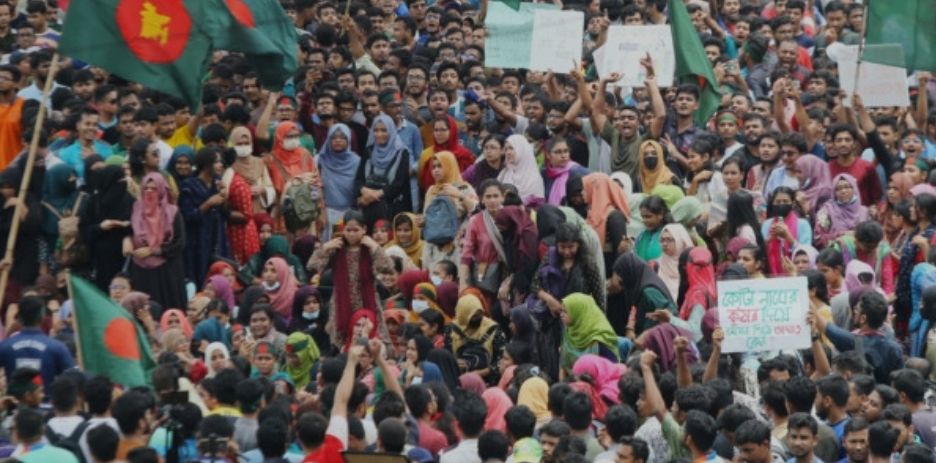
After almost six years of ups and downs since, following a student-led movement that started at the beginning of July this year around civil service job quotas and finally morphed into the demand for resignation of the government, and after more than 600 lives were lost in two weeks, Sheikh Hasina capitulated and fled Bangladesh on August 5, 2024.
The purpose of this article is not to recap the past 16 years, but to outline some thoughts, sentiments that have been expressed by me and many others within the diaspora on social media over the years. Many did not have the courage to express them from within Bangladesh.
I was shocked over the past few years by the pride and arrogance of Awami League leaders who were questioned about the government’s misdeeds on various talk shows on Bangladesh’s private TV channels, and their tendency to put all blame on the 2001-2006 BNP-Jamaat government. They had mastered all the tricks in the book to avoid answering questions. I became convinced of the political bankruptcy of the Awami League and of their imminent downfall.
At the same time, from what I heard from the former Prime Minister Sheikh Hasina to top-level ministers on various issues, I realised that the government could easily be termed as “tone deaf”. Over time, it also became apparent to me that Hasina lived in a glass house of her own making, the walls of which were her chosen confidants, who told her only what she wanted to hear and believe.
Gradually and with precision, Hasina and her confidants took away the freedom of speech of one section of the society, in order to establish their imaginary world as reality, while filling every part of the state with more confidants and sycophants to bring them under their control. The distinction between Sheikh Hasina and the state disappeared.
There was an attempt to identify criticism of Hasina as an anti-Bangladesh doctrine. Those who made such criticisms were labelled as “Razakars” (national traitors in the local context). In addition, many people had disappeared, were imprisoned for an indefinite period, subjected to physical and mental torture, and in some cases murdered.
These experiences were not only of people of the opposition parties. They happened to many who had a conscience and dared to protest against the activities of the beleaguered regime. Many journalists, writers and social workers were in constant fear of when and at what time of the night the men in white clothes (from the detective branch) would knock on the door and take them away.
Many of those who did not wish to live in such terror enrolled themselves in the list of Hasina’s cronies through flattery. No profession was left out of this endeavour. What unlimited corruption? What abuse of unlimited power? What violation of laws? These people competed with each other, obsessed with obtaining as much security as possible from the mafia-like administration, and looting and smuggling abroad as much wealth as possible.
The Awami League government thought that there was no harm in running the country that way, as long as the masses could be kept enamoured with some flashy infrastructure, and as long as the country’s economic performance numbers kept making headlines. But what an irony of fate! The Covid pandemic threw all those plans into disarray. It was then that the public began to discover the extent of economic mismanagement, wrong decisions and the inflated budgets of mega-projects hidden behind the glitz.
But those were symptoms. The real ailment was the fascist administration put together by Hasina over time. In order to continue this fascist government, Hasina used subservient courts to remove the provision of a caretaker administration to oversee elections from the constitution, against the wishes of the majority of the Bangladeshi people, thus pushing the country into political darkness.
As a result of this, Bangladesh had the ignominious experience of three farcical elections in a row. Currently, an entire generation does not know what it means to vote and have it properly counted. It does not know what an independent judiciary means. It has never seen a functioning Parliament. It does not know what a democratic country looks like.
It does not know what a neutral and strong media is. It does not know what is meant by accountability of the state. It does not know what rights are enshrined in the Constitution of Bangladesh. All that is known is the demonic duo of the police forces (including the Rapid Action Battalion or RAB) and intelligence or detective forces. All that are known are the useless, ineffective and bribe-seeking government bureaucrats who think they are kings.
The generation of 1971 and the generation after that did not know how to free the country from this hell, because many among them had become beneficiaries of the profitable aspects of that hell. For the first time in the country, I saw countless oligarchs who were above everything (and Hasina’s new confidants and bank-loan defaulters of unprecedented levels).
On the other hand, economic disparity increased to such a level that a section of the middle class began to face poverty. Unemployment rates started to rise. After the epidemic and the Russia-Ukraine war, inflation had decreased all over the world, but not in Bangladesh. Economic mismanagement induced currency (Taka) depreciation which, coupled with government-backed domestic market cartels (locally referred to as syndicates), rendered the lives of the common people unbearable.
In other words, it can be said that Sheikh Hasina and the Awami League, which had played politics with the ideals of Bangladesh’s birth (i.e. that of the war of liberation) for so long, had started to govern the country in a way that was gradually void of all those ideals since assuming power in 2009. They did not even hesitate to abandon secularism in their greed for power.
Today is a new day whose future is yet to be painted on a white canvas. Let us not find even a shadow of fascism in the picture that we will see in the future. Bangladesh has spent more than ten years in a suffocating cell. The freedom fighters of 1971 did not dream of such a country. This year’s students and martyrs did not give their blood to see a repetition of hell.
 রাষ্ট্রীয় ধর্মীয় নিরপেক্ষতা এবং ব্যক্তিগত ও রাষ্ট্রীয় গৌণ ধর্মীয়তা - State Religious Neutrality and Personal & State Peripheral Religiosity